
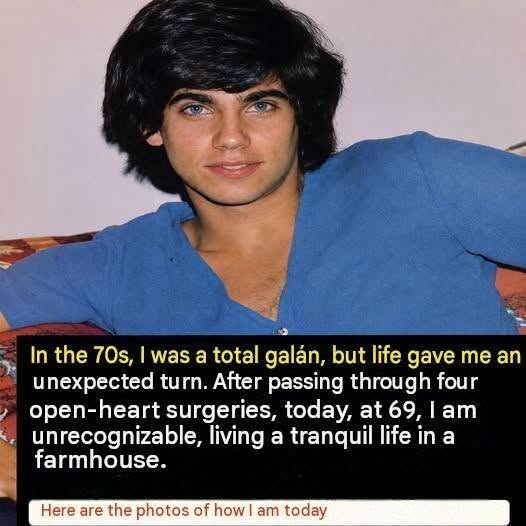
From Teen Idol to Life Mentor: The Remarkable Journey of Robby Benson
For many people who grew up watching movies in the 1970s, Robby Benson was more than just another young actor. With his dark hair, gentle personality, and unmistakable screen presence, he became one of the era’s most recognizable teen idols.
But the story of Robby Benson did not end when the teen-idol years faded.
Over the decades, he transformed himself from a young Hollywood heartthrob into an actor, filmmaker, director, composer, author, professor, and voice performer. For a new generation, he became especially recognizable as the voice of the Beast in Disney’s beloved animated classic Beauty and the Beast.
And decades after his rise to fame, Benson continues to demonstrate that a successful career does not have to follow a single path.
A Performer From an Early Age
Born Robin David Segal on January 21, 1956, in Dallas, Texas, Benson entered show business while he was still young. He eventually adopted his mother’s maiden name, Benson, as his professional name.
His early career included theater, television, and film. He appeared on Broadway and worked in productions including The Rothschilds and The Pirates of Penzance. His experience on stage gave him a foundation that would later become important as his career expanded beyond acting.
By the early 1970s, he was beginning to attract much more attention on screen.
The Rise of a 1970s Teen Idol
The 1970s were an extraordinary period for young stars. Teen magazines, television movies, and coming-of-age films could transform a talented young actor into a household name almost overnight.
Benson became part of that phenomenon.
His performances in films such as Jory and Jeremy brought him attention from both audiences and critics. His performance in Jeremy earned him a Golden Globe nomination, while the film itself received recognition at the Cannes Film Festival.
Suddenly, Benson was no longer simply a young actor trying to establish himself.
He was a genuine teen idol.
His popularity grew even further with Ode to Billy Joe, released in 1976. The movie gave him one of his most memorable early roles and helped establish him as one of the recognizable young leading men of the decade.
The Role That Made Him a Heartthrob
Then came Ice Castles in 1978.
The romantic drama became one of the films most closely associated with Benson’s youthful image. His performance as Nick Peterson, a young hockey player, introduced him to an even wider audience.
For many viewers, this was the Robby Benson they remembered most clearly: the handsome, sensitive young man at the center of an emotional love story.
But Benson was already thinking beyond being a romantic leading man.
He wanted to create.
He Was More Than an Actor
One of the most interesting aspects of Benson’s career is that he began moving behind the camera relatively early.
He co-wrote One on One, a 1977 basketball drama, with his father, Jerry Segal. Benson didn’t simply appear in the movie; he helped develop the story and screenplay. His official biography notes that he sold the screenplay to Warner Bros. when he was only 18.
This was an early indication that his ambitions extended beyond acting.
He wanted to understand the entire filmmaking process.
Over time, that interest developed into directing and producing. Benson eventually directed episodes of numerous television series, including Friends, Ellen, Sabrina the Teenage Witch, Jesse, and other network productions. His official biography says he directed more than 100 episodes of television.
The Role That Introduced Him to a New Generation
For an actor who had already enjoyed a successful career, the early 1990s brought a completely new opportunity.
Disney’s Beauty and the Beast introduced Benson’s voice to millions of younger viewers.
He provided the voice of the Beast in the animated classic, a role that became one of the defining performances of his career.
The character was very different from the handsome young heroes Benson had played in the 1970s.
The Beast begins as an angry, isolated, and emotionally closed-off character. As the story progresses, however, he learns compassion, humility, and love.
Benson’s performance helped give the character a human emotional quality beneath the fantasy.
As a result, people who had never seen Benson’s earlier movies suddenly knew his voice.
A Career Behind the Camera
While continuing to act and provide voice work, Benson increasingly established himself as a television director.
He directed episodes of well-known programs, including Friends, Ellen, Evening Shade, Sabrina the Teenage Witch, and Jesse.
This second chapter of his career was particularly significant because it allowed him to move away from the narrow image of the 1970s teen idol.
He wasn’t simply trying to recreate the past.
He was building something new.
A Difficult Personal Chapter
Benson’s life also included serious health challenges.
He has spoken publicly about undergoing open-heart surgery and the effect that his health experiences had on his life and career. Those experiences eventually inspired creative work, including his memoir I’m Not Dead… Yet! and the musical Open Heart.
Instead of allowing a difficult period to define him, Benson incorporated the experience into his artistic work.
Continue reading on the next page